The High-Grade Authority Stream
1750s–1760s — France forms working models for Scottish high degrees and delegated powers.
1762 — Constitutional language and delegation frameworks circulate in the French sphere.
1770s–1790s — French-Antillean councils and inspectors sustain the haut grades in Saint-Domingue.
1806–1807 — Authority crosses through Cuba and takes root in New York under Cerneau.
19th century — The European custody line preserves the current to John Yarker and beyond.
High Degrees · Sovereignty · Documentary Continuity
Sovereign Grand Council 33°
Of the Ancient Scottish Rite of Héredom 1807™
The Sovereign Grand Council of the 33rd and Last Degree is the governing summit of the Ancient Scottish Rite of Héredom 1807™,
preserving the integrity of the degrees 4° through 33° in continuity with the French and French-American Antillean transmission.
This page is built as a museum-grade presentation: authority, chain of custody, archival anchors, and institutional references — so that
any serious reader understands immediately that this is not a modern invention, but a documented current.
UNIVERSI TERRARUM ARCHITECTONIS MAGNI AD GLORIAM INGENII
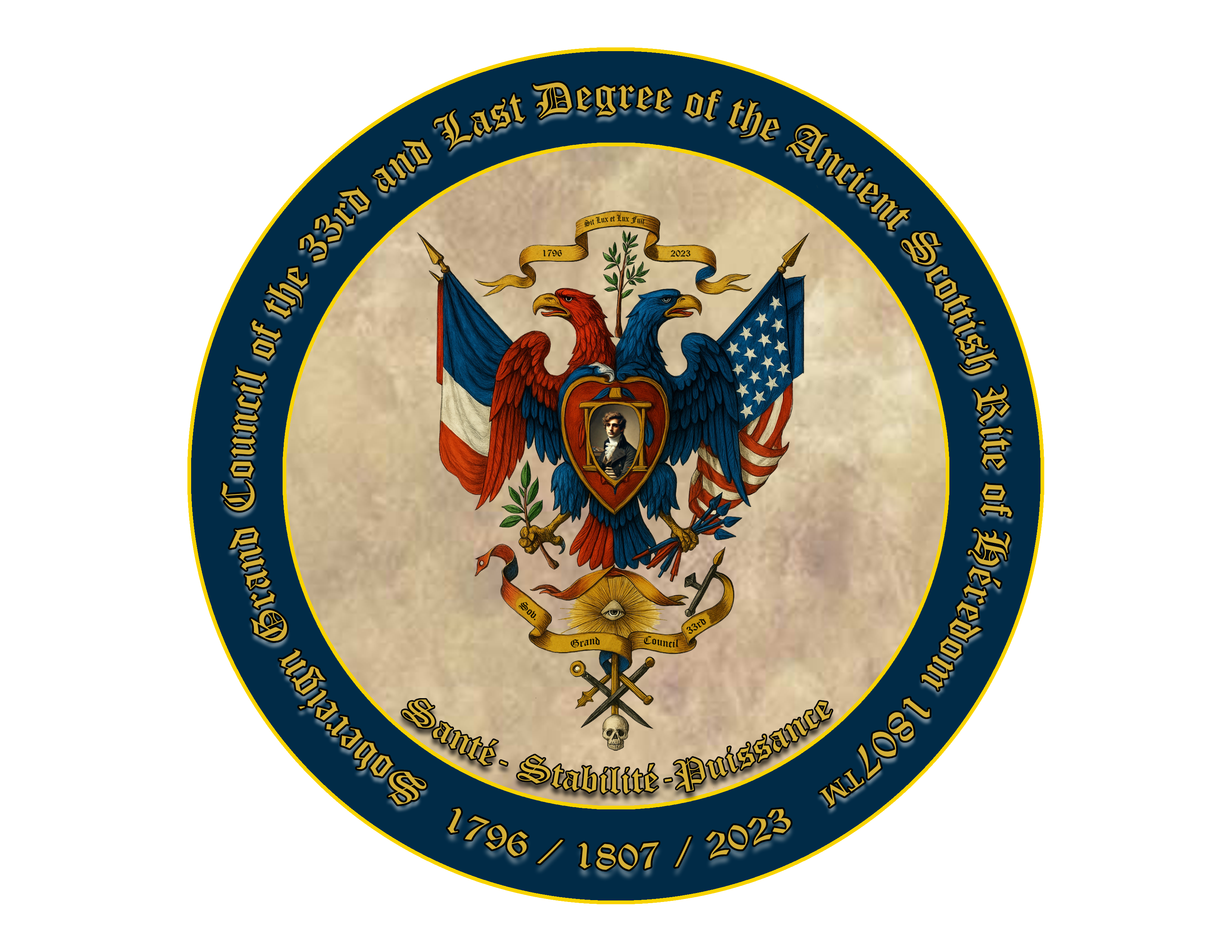
SIT LUX ET LUX FUIT
Authority & Jurisdiction
The Sovereign Grand Council acts as the final authority of the Rite for the haut grades, maintaining the standards of legitimacy:
valid transmission, documentary continuity, and sovereign governance by warrant and constitution.
The Council governs high-degree bodies under its obedience and coordinates in harmony with the Craft constitution (GOUSA),
while preserving jurisdictional separation: Craft remains Craft; the high degrees remain the high degrees.
What Makes This “Museum-Grade”
A serious rite is recognized by its paper trail: charters, deputations, registers, circulars, ritual witnesses, and institutional repositories.
This Council maintains that posture publicly: it cites where the record lives, who holds it, and how it is verified.
We do not ask the world to “trust us.” We show the architecture of custody — France, the Antilles, New York, and Europe — and then we let the record speak.
Chronology of the High Degrees
A clean authority narrative from France → Antilles → New York → Europe
France – 1750s–1760s
French high-degree culture expands rapidly, with governance patterns that include delegation, patents, and inspectors empowered to work across jurisdictions.
This becomes the blueprint for international transmission later used in colonial and transatlantic contexts.
Saint-Domingue – 1770s–1790s
The French-American Antilles become a functional laboratory for high-degree administration: councils, chapters, and inspector authority operate in real time,
surviving upheaval and exile by traveling with the men entrusted to keep the degrees alive.
Cuba – 1806
The displacement stream passes through Cuba. Preservation happens here: not as theory, but as continuity under stress — the sign of an authentic current.
New York – 1807
The Rite is organized on American soil in New York in the Cerneau current, aligned to the French-Antillean inheritance rather than local American inventions.
Europe – Custody to John Yarker
The European custodianship line preserves documentary survivals, cross-recognitions, and the continuity claim into the Yarker museum era —
where artifacts, papers, and exhibits become public anchors.
Archives & Institutional Anchors
This Council’s posture is archival: we cite where the record is housed and preserved by recognized repositories and museum institutions.
The following anchors are referenced for verification and research continuity:
BnF – France (FM Series / GOdF archival sphere)
French documentary custody of the period record (including FM1 dossiers and related French high-degree papers).
These holdings function as primary anchors for the French and French-colonial transmission record.
Freemasons’ Hall – London (Museum / Exhibits)
Institutional custody of British Masonic history and exhibit-grade materials relevant to the European preservation environment.
Manchester (Museum holdings associated with Yarker-era materials)
Custodial reference point for Yarker-associated historical survivals and exhibit context in the North of England.
Scottish Rite Masonic Museum & Library – Lexington, Massachusetts
An American research repository preserving key documents (including the “Circular throughout the Two Hemispheres, 1802” record entry you provided),
allowing comparison between claims, circulars, and surviving documentary custody.
The point is simple: legitimacy lives where the paper lives. This page tells visitors exactly where to look.
Petitions & Admission
The Sovereign Grand Council receives petitions for affiliation and advancement strictly by proper inquiry, character,
and lawful recommendation. We preserve formal protocol: no shortcuts, no “mail-order” dignities, no improvisations.
If you seek a serious high-degree path under the Ancient Scottish Rite of Héredom 1807™, petition properly —
and be prepared to document your standing, your Craft foundation, and your intent.